
ARISTOI Model
Complex change requires coherence
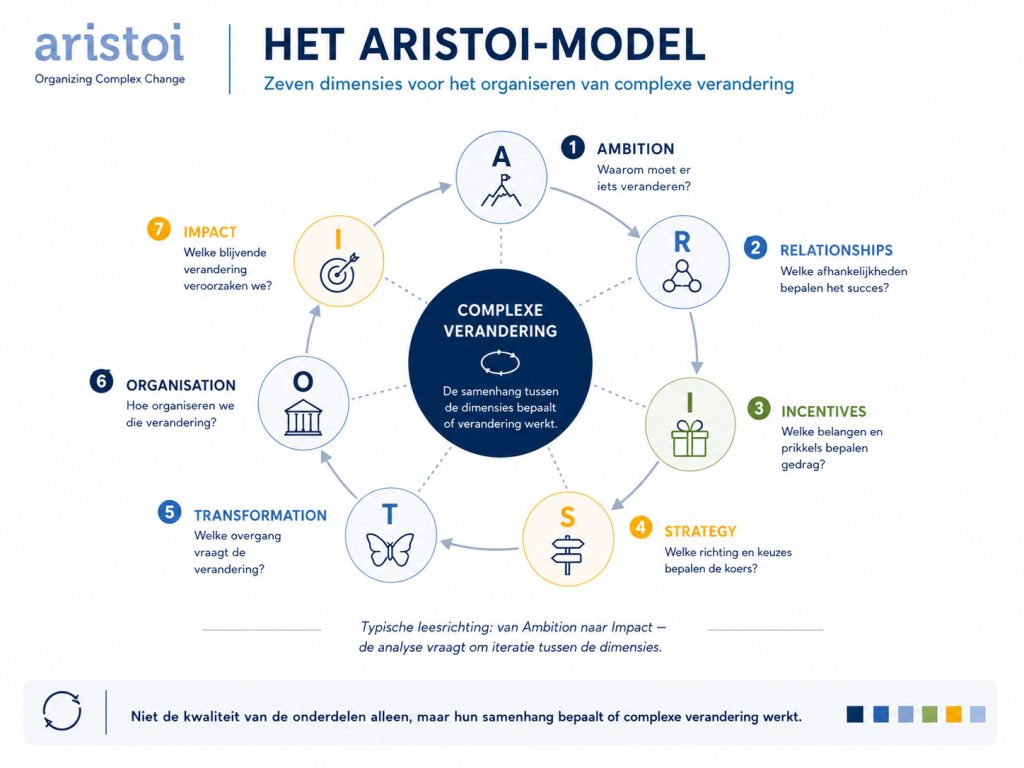
Complex change initiatives rarely consist of a single problem. Strategy, interests, collaboration, funding, working methods, and organization are constantly intertwined. The ARISTOI model breaks down this interrelationship into seven dimensions:
Ambition, Relationships, Incentives, Strategy, Transformation, Organization, and Impact.
Together, they form a framework for understanding, organizing, and strategically steering complex change— from ambition to lasting impact.
Why this model?
A program may have a bold vision, a compelling strategy, and strong partners—and yet still struggle to make progress.
This often happens because decisions that make sense individually do not align well with one another. For example, the strategy calls for joint implementation, while budgets and mandates remain with individual organizations. Or partners may share the same ambition but have different incentives to actually take action.
The problem, then, does not necessarily lie in the individual parts, but in how they fit together.
The ARISTOI model helps bring precisely those tensions to light.
Seven Dimensions of Complex Change
Ambition
: What change do we truly want to bring about, why is it necessary, and for whom?
Relationships
Which parties and dependencies determine whether the change can succeed?
Incentives
What interests, incentives, costs, benefits, and risks drive the behavior of the parties involved?
Strategy
: What choices and priorities do we make—and what do we consciously choose not to do?
Transformation
What actually needs to change in terms of work methods, capabilities, routines, knowledge, or behavior?
Organization
How are ownership, mandate, roles, governance, and decision-making structured?
Impact
What lasting change do we ultimately want to achieve—and how do we know that it’s actually happening?
Ambition describes the intention. Impact reveals what has actually come of it. The five dimensions in between determine how the change is organized.
Not seven steps
The ARISTOI model is not a linear step-by-step plan.
There is a natural progression from Ambition to Impact, but in real-world change initiatives, you’re constantly moving between these dimensions.
For example, a strategic decision may require new partners. A financial interest may have implications for governance. During implementation, it may become apparent that mandates need to be restructured. And new insights may even provide a reason to further refine the original ambition.
Complex change develops through the ongoing interaction among the seven dimensions.
That is why we do not use the model as a checklist, but as a system of interconnected questions.
Alignment is the key
The strength of the model lies not only in the seven dimensions individually, but above all in the alignment among them.
For example:
The strategy requires joint implementation, while mandates, budgets, and accountability remain with individual organizations.
In and of themselves, both choices can make sense. Each party can act rationally based on its own position.
Still, the whole thing isn't moving forward enough.
That's what we call a misalignment: two or more components of the change initiative are justifiable on their own, but they do not reinforce each other—or may even work against each other.
That is precisely where delays, recurring discussions, unclear ownership, and problems with implementation or scaling up often arise.
From Model to Application
The ARISTOI model is not an end in itself.
We use it to gain a faster understanding of complex challenges, identify the main obstacles, and determine which intervention can truly make a difference.
The ARISTOI Alignment Scan uses the diagnostic model: where is the coherence lacking, and what decisions are needed?
Strategic Design then applies those same insights to the design process: How should ownership, roles, governance, partners, incentives, and decision-making be structured to make progress?