
ARISTOI Alignment Scan
Where is the real bottleneck?
Complex programs rarely get stuck because of a single component. More often than not, ambition, interests, strategy, organization, and implementation are not sufficiently aligned.
The ARISTOI Alignment Scan highlights where that alignment is lacking—and what decisions are needed to move forward.
Sound familiar?
A program can be strong in terms of content and still struggle to make progress.
The strategy is clear, but implementation is lagging.
The parties are at the table, but the same discussions keep coming up.
Ownership and the mandate are not clearly defined.
Decisions are made, but they don't lead to enough action.
A pilot program works, but scaling it up isn't getting off the ground.
Everyone is doing their part, but no one has a big-picture view.
In that case, the problem often isn't with a single component, but with how they work together.
The Alignment Scan examines the correlation
Not every component of a program has to be weak for the change to stall. For example, a well-defined strategy may conflict with existing mandates. Partners may endorse the same ambition, while their interests and incentives point in a different direction.
The ARISTOI Alignment Scan therefore looks not only at the individual components, but especially at the connections between them.
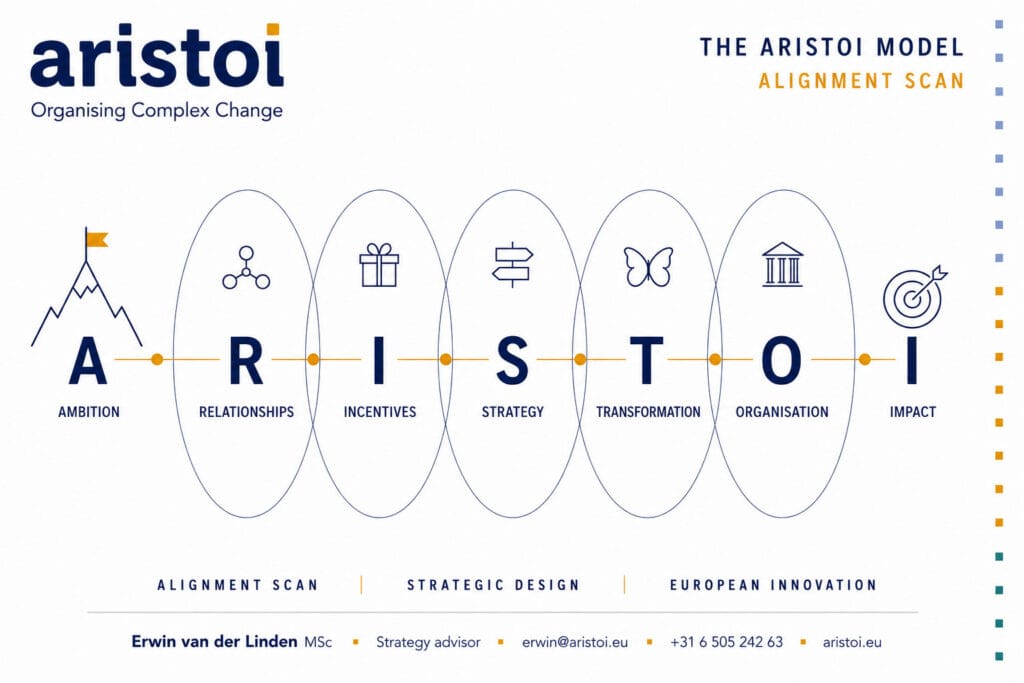
We are examining seven dimensions
Ambition — What change do we truly want to bring about?
Relationships — What dependencies determine success?
Incentives — What interests and incentives drive behavior?
Strategy — What choices and priorities have been made?
Transformation — What needs to change in terms of processes, capacity, or behavior?
Organization — How are ownership, mandate, and decision-making structured?
Impact — What lasting change must be demonstrably achieved?
A typical misalignment
The strategy calls for joint implementation, while mandates, budgets, and accountability remain with individual organizations.
Each party acts logically from its own position. Yet the overall effort is not making sufficient progress.
What are the benefits of the Alignment Scan?
Not a long list of observations, but a sharp analysis of the issues that are holding things back—translated into concrete decisions.
Diagnosis
3–5 key misalignments, supported by findings from documents and interviews.
Decision Points
Clear decisions regarding ownership, mandate, priorities, collaboration, and implementation.
Promotion
Specific actions and a 90-day plan to overcome the main obstacles.
You will receive
- an executive change brief;
- an alignment and misalignment analysis;
- the main risks and consequences; specific decision points;
- intervention options;
- a 90-day planner;
- an executive briefing on the findings.
How does it work?
A concise review, without a lengthy consultation process.
1. Intake & Document Analysis
We begin by reviewing the project brief, relevant plans, strategies, governance agreements, and other available documentation.
3. Alignment Analysis
We examine the seven dimensions and distill the key misalignments, risks, and dependencies into a clear diagnosis.
2. In-depth discussions
Targeted discussions with the client and several key individuals test assumptions, interests, and perceived obstacles.
4. Discussion & Decision Agenda
The findings are discussed in an executive session and translated into concrete decision points, interventions, and a 90-day agenda.
Processing time: typically about 10 business days, depending on the scope and availability of the parties involved.
When is a Alignment Scan relevant?
An Alignment Scan is particularly valuable when the vision is clear, but collaboration, organization, or implementation aren't falling into place on their own.
A program is struggling to get off the ground
There is ambition and a plan, but decision-making, ownership, and capacity are lagging behind.
The same discussions keep coming up
The parties talk to each other regularly, but underlying interests or responsibilities remain unresolved.
A collaboration should enter the next phase at
. An initiative grows, gains more partners, or requires clearer governance and decision-making.
A pilot program needs to be scaled up
The solution works, but there is a lack of long-term funding, ownership, or implementation.
A consortium is losing its way
Work packages, partners, and expectations are beginning to diverge.
A strategy requires real change
The course has been set, but routines, mandates, and the organization are not yet aligned with the new ambition.
Especially when it’s not immediately clear exactly where the problem lies, a Alignment Scan can be valuable.
Built on experience with complex collaborative projects
The Alignment Scan builds on experience with programs in which responsibilities are shared, interests differ, and no single party can steer the whole process on its own.
MoVe – Smart Logistics South Holland
Regional collaboration between government agencies and other stakeholders on smart and future-proof logistics. The challenge requires joint implementation, while responsibilities, resources, and mandates lie with individual organizations.
Role: independent process management, prioritization, and strengthening ownership and implementation capacity.
South Holland Inland Port Collaboration
Development of a structural collaboration between the province and municipalities regarding inland ports and waterfront business parks.
Role: structuring the joint initiative and developing a practically feasible administrative framework for roles, governance, decision-making , and a follow-up strategy.
And then what?
A Alignment Scan doesn’t have to end with the diagnosis. Once it’s clear where the main obstacles lie, ARISTOI can help you actually design the necessary changes.
Strategic Design translates the diagnosis into decisions regarding ownership, roles, governance, partners, incentives, financing, and decision-making.
Not sure where exactly the problem is?
That’s actually a good time to review the task together. An initial discussion starts with the problem, not with a predetermined solution.